- Contact Us Now: (315) 234-4935 Tap Here To Call Us




Before You Hit Record: New York’s Rules on Recording Your Co-Parent


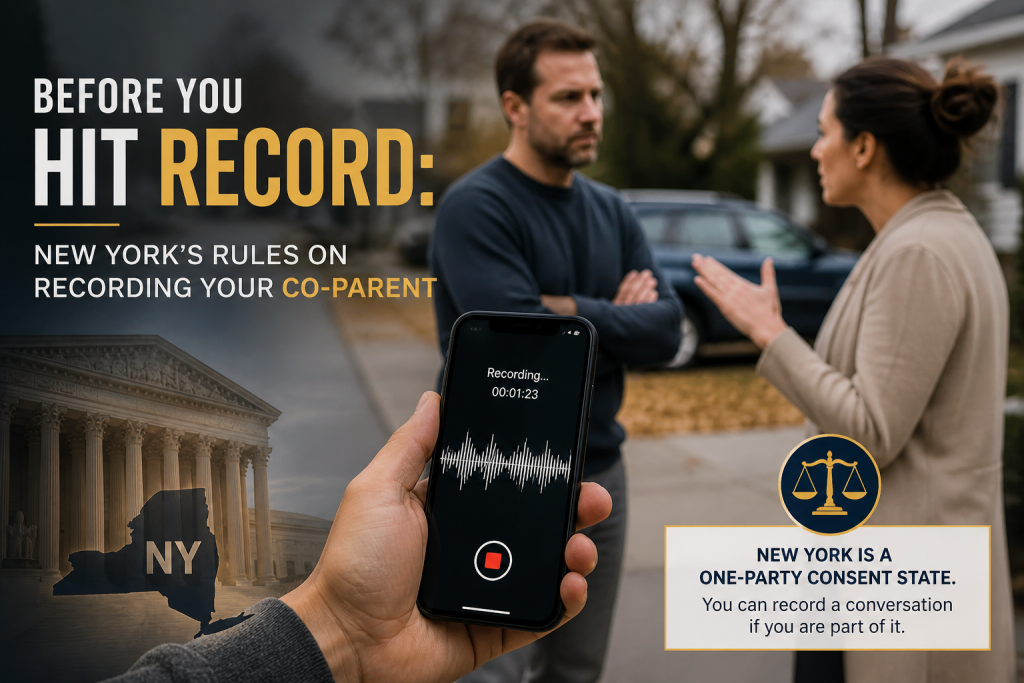
When co-parenting relationships break down, the impulse to document everything is understandable. Maybe the other parent is denying what they said. Maybe you’re worried about what’s happening during their parenting time. Maybe you just want proof. So you pull out your phone and hit record. Before you do, there are things you need to understand, because in New York, recording the other parent can either protect you or seriously damage your case, depending on how it’s done. In this post, a Syracuse custody attorney explains what you need to know.
New York’s Wiretapping Law: The One-Party Consent Rule
New York Penal Law § 250.05 makes it a crime to unlawfully engage in wiretapping or mechanical overhearing of a conversation. However, one-party consent generally applies, meaning that if you are part of the conversation, you may record it without telling the other person. In plain terms: if you are on the phone with your co-parent and you record that call, you have likely not broken any law. The same is generally true for an in-person conversation you are participating in.
What you cannot do is record a conversation you are not part of. Placing a recording device in the other parent’s home, car, or on your child to capture conversations without your participation crosses into illegal territory under both state and federal law.
One of the most common mistakes parents make is sending a child with a recording device, a phone tucked in a backpack, a tablet left on, to capture what happens in the other parent’s home. Courts take a dim view of this and it will almost certainly be treated by the judge as a sign of bad parenting judgment. In custody cases, courts are always evaluating which parent better supports the child’s relationship with the other parent and exercises sound decision-making. Using your child as a surveillance tool cuts directly against both of those standards.
When Recordings Can Help Your Case
Legally obtained recordings can be valuable evidence in family court proceedings. Common examples include:
- Voicemails and text messages. These are recordings or documented communications you already have access to. Screenshots of threatening or harassing texts, saved voicemails, and email threads are routinely admitted in New York family court.
- Phone call recordings (with you as a participant). If your co-parent is threatening you, making promises they later deny, or violating court orders during a conversation you are part of, a recording of that call may be admissible and persuasive.
- Video at exchanges. Some parents use doorbell cameras or dashcam footage to document what happens during custody drop-offs and pickups. This can be legitimate evidence of harassment, missed exchanges, or violations of protective orders, provided the recording takes place in a public or semi-public area.
- Your own home. Recording inside your own residence is generally permissible in New York, as you are a party present in that space.
When Recordings Backfire
Even legal recordings don’t always help, and sometimes they actively hurt. Judges notice obsessive documentation. A parent who has recorded dozens of conversations, compiled surveillance logs, and built an elaborate evidence binder can come across as hostile, paranoid, or focused on winning rather than on their child. Family court judges are experienced at recognizing this dynamic, and it can color how they view everything you present.
- Out-of-context clips are dangerous. A snippet of an argument, without what preceded it, can be taken the wrong way. If the other parent’s attorney plays the full audio and it shows you escalating, you’ve handed opposing counsel a gift.
- It can be used to justify a custody modification. If a court finds you’ve been secretly recording the other parent, conducting surveillance, or involving your children in information-gathering, that behavior may itself become a basis for changing the custody arrangement.
- Federal law complications. If either party is in a different state, federal wiretapping laws apply, and some states require all parties to consent to a recording. If you record a phone call with a co-parent who is in California, Florida, or another two-party consent state without their knowledge, you may have committed a federal crime even if you’re in New York.
Contact A Syracuse Custody Attorney Today
Recording the other parent is not automatically illegal in New York, but it is rarely as simple or as helpful as parents expect and even legally obtained recordings can damage your credibility if the court concludes you are more focused on building a case than on your child. If you are considering recording your co-parent, talk to a family law attorney first. What feels like smart preparation can quickly become the worst thing you did for your custody case. Contact us today for a confidential consultation with an experienced Syracuse custody attorney.
For more information on child custody proceedings, please visit our Child Custody and Frequently Asked Questions pages
Disclaimer: This blog post is for informational purposes only and does not constitute legal advice. Laws and guidelines can change, so always verify with current statutes or a professional.

Address
| Monday | 8:30 AM - 4:30 PM |
| Tuesday | 8:30 AM - 4:30 PM |
| Wednesday | 8:30 AM - 4:30 PM |
| Thursday | 8:30 AM - 4:30 PM |
| Friday | 8:30 AM - 4:30 PM |
| Saturday | Closed |
| Sunday | Closed |
Contact Us Now