- Contact Us Now: (315) 234-4935 Tap Here To Call Us




School Enrollment After Separation: A New York Parent’s Guide


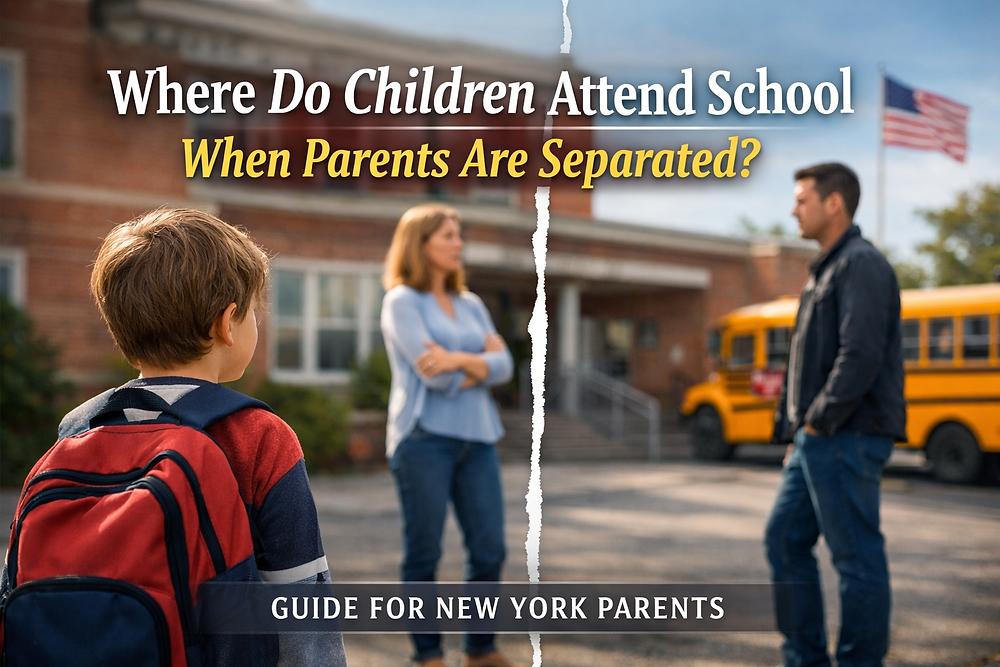
One of the most practical, and sometimes contentious, issues that arises when parents separate is determining where their children will go to school. School enrollment may seem straightforward, but it can quickly become complicated when parents live in different school districts, disagree on schooling choices, or share custody across county lines. Understanding how New York State law addresses these situations can help parents navigate the process with less conflict and greater clarity. In this post, a Syracuse custody attorney explains what you need to know.
School Enrollment and Residency in New York
In New York, public school enrollment is primarily determined by where a child resides. Under New York Education Law § 3202, children are entitled to attend school in the district where they are residents. When parents live apart, this raises an immediate question: which parent’s address governs enrollment?
Generally, the child’s primary residence, the home where they spend the majority of their time, will serve as the basis for determining school district. If a custody order or parenting plan designates one parent as the primary residential parent, that parent’s address typically controls school enrollment. However, if parenting time is relatively equal and parents live in different school districts, the answer becomes less clear-cut. Courts and school districts must then look more carefully at the specific facts, including the child’s established ties to a particular community and school.
What Happens When Parents Disagree?
Disagreements over school choice are among the most frequently litigated post-separation issues in New York family courts. Common disputes include:
- One parent relocating to a different school district and seeking to enroll the child there
- Disagreement over public versus private school
- One parent preferring a specialized program or charter school over the local public school.
- Disputes over school choice after a move prompted by a custody modification
When parents share legal custody, which is the norm in New York, both parents have an equal right to participate in major educational decisions. This means that neither parent can unilaterally change a child’s school without the other’s consent, unless a court order specifically grants one parent decision-making authority over education.
If the parents cannot agree, either parent may petition the court for a resolution. The court will apply the best interests of the child standard, examining factors such as:
- The child’s relationship with classmates, teachers, and the broader school community
- Academic performance and any special educational needs
- Proximity of each school to both parents’ homes
- The child’s age and, in some cases, the child’s preference
- The stability and continuity of the child’s current educational placement
Relocation and School District Changes
When a custodial parent wishes to move, even within New York State, to a different school district, the move can significantly affect the other parent’s parenting time and the child’s school enrollment. New York courts take parental relocation seriously. Under the framework established by the New York Court of Appeals in Tropea v. Tropea, courts balance the legitimate reasons for the move against the potential impact on the child’s relationship with the non-relocating parent. A change in school district is one tangible consequence courts weigh when considering relocation requests. If you are the relocating parent, it is important to provide advance notice and, if possible, seek the other parent’s consent before moving. If the other parent objects, you will likely need to seek court approval before relocating with the children.
Private School, Homeschooling, and Special Education
When one parent wants to enroll a child in private school or pursue homeschooling, the same joint legal custody principles apply, both parents must agree, or a court must decide. Courts will consider the cost of private schooling, whether one or both parents are willing and able to contribute financially, and the educational benefits to the child. For children with disabilities or special needs, New York law and federal law under IDEA require that children receive a free appropriate public education in the least restrictive environment. Both parents generally have the right to participate in Individualized Education Program (IEP) meetings and decision-making, regardless of custody status.
Practical Tips for Separated Parents
- Include school-related provisions in your parenting plan. Specify which school district will govern enrollment, how disputes will be resolved, and how each parent will be kept informed of school events and communications.
- Notify the school of your custody arrangement. Provide the school with a copy of any custody order so that both parents are recognized as having the right to receive records and attend conferences.
- Try to agree on major school decisions before they arise. Proactively discussing school transitions, such as the move from elementary to middle school, can prevent conflict later.
- Document your involvement. Keep records of your participation in school activities, communications with teachers, and attendance at school events. This documentation can be relevant if a dispute goes to court.
Contact A Syracuse Custody Attorney Today
School-related disputes between separated parents can escalate quickly and carry long-term consequences for your children and your custody arrangement. If you are facing a school enrollment dispute, a potential relocation, or difficulty enforcing your right to participate in educational decisions, speaking with a knowledgeable New York family law attorney can help you understand your rights and take the appropriate steps to protect your child’s best interests. Contact us today for a confidential consultation with an experienced Syracuse custody attorney.
For more information on child custody proceedings, please visit our Child Custody and Frequently Asked Questions pages
Disclaimer: This blog post is for informational purposes only and does not constitute legal advice. Laws and guidelines can change, so always verify with current statutes or a professional.

Address
| Monday | 8:30 AM - 4:30 PM |
| Tuesday | 8:30 AM - 4:30 PM |
| Wednesday | 8:30 AM - 4:30 PM |
| Thursday | 8:30 AM - 4:30 PM |
| Friday | 8:30 AM - 4:30 PM |
| Saturday | Closed |
| Sunday | Closed |
Contact Us Now