- Contact Us Now: (315) 234-4935 Tap Here To Call Us




How Does Evidence Work in a New York Child Custody Matters?


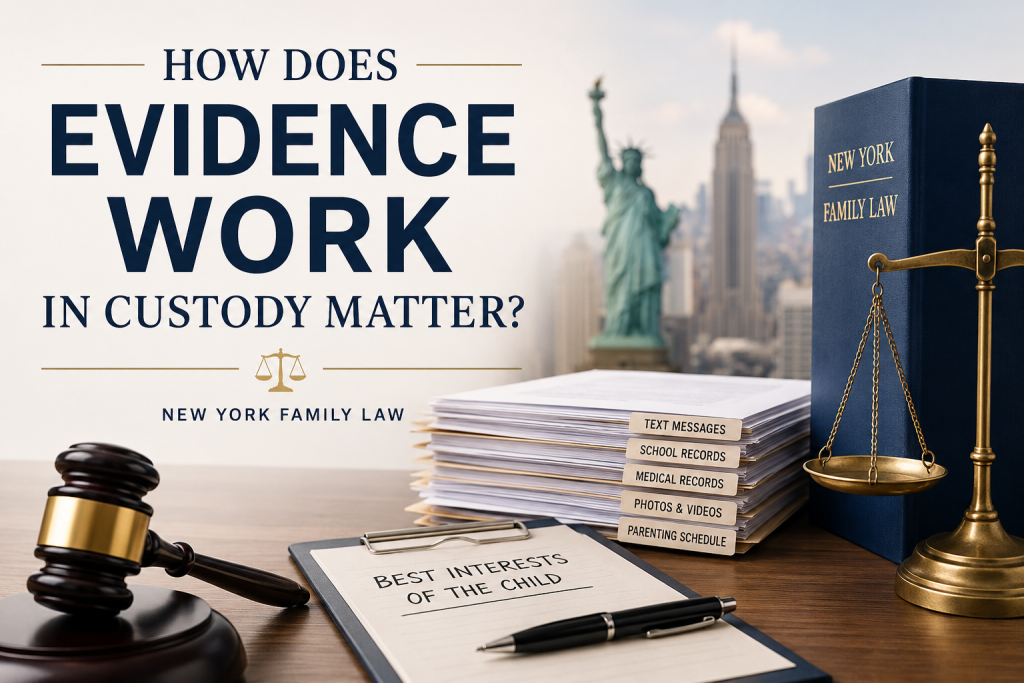
When parents are involved in a custody dispute, many assume the case will come down to who is “telling the truth.” While the credibility of the parties is important, evidence, what can actually be proven to the court through testimony, documents, records, and other admissible information, is what many cases ultimately turn on. Understanding how evidence works in a custody matter can help parents avoid costly mistakes and better prepare for litigation in both Family Court and Supreme Court divorce proceedings. In this post, a Syracuse custody attorney explains what you need to know.
The Court’s Focus: The “Best Interests of the Child”
In New York, custody decisions are governed by the “best interests of the child” standard. Courts consider a wide range of factors, including:
- Each parent’s ability to provide stability
- The child’s relationship with each parent
- Communication and co-parenting ability
- Domestic violence concerns
- Mental and physical health of the parties
- Educational and emotional needs of the child
- Each parent’s willingness to foster the child’s relationship with the other parent
Because these issues are fact-intensive, evidence becomes critically important.
What Counts as Evidence in a Custody Case?
Evidence generally falls into several categories.
Testimony
The most common form of evidence is live testimony under oath. This may include:
- The parents
- Family members
- Teachers
- Therapists
- Police officers
- Medical professionals
- Childcare providers
- Other witnesses with firsthand knowledge
A judge evaluates not only what witnesses say, but also credibility, consistency, and demeanor.
Documents and Records
Documents often play a major role in custody litigation. Common examples include:
- School records
- Medical records
- Attendance reports
- Therapy records (when legally admissible)
- Police reports
- Orders of protection
- CPS records
- Emails and text messages
- Parenting schedules and calendars
The court generally prefers objective records over unsupported accusations.
Text Messages, Emails, and Social Media
Digital evidence is increasingly common in custody matters. Courts frequently review:
- Text message conversations
- Emails between parents
- Social media posts
- Photos and videos
- Parenting app communications
However, not every screenshot automatically becomes evidence. The party offering the evidence usually must establish that the messages are authentic and relevant. For example, a parent claiming the other routinely refuses parenting time may introduce:
- Timestamped text messages
- Missed exchange logs
- Emails confirming cancellations
- App communication histories
At the same time, judges often dislike excessive or trivial digital evidence. Hundreds of hostile text messages may ultimately hurt both parties.
Hearsay: One of the Most Misunderstood Rules
Many custody litigants are surprised to learn that not everything someone says can be admitted in court. “Hearsay” generally refers to an out-of-court statement offered to prove the truth of the statement. Hearsay is often inadmissible unless an exception applies. For example:
- “My neighbor told me the father leaves the child home alone” may be hearsay.
- A medical record created during treatment may qualify under a hearsay exception.
- Statements made by a child can involve complex evidentiary rules depending on the circumstances.
Custody cases often involve numerous hearsay disputes, particularly where allegations of abuse, neglect, or parental alienation are involved.
Can the Child Testify?
In many New York custody matters, the judge will conduct a private “Lincoln hearing,” named after the case Lincoln v. Lincoln. During this proceeding:
- The child speaks privately with the judge
- Parents are generally excluded
- The conversation is sealed from the public record
The purpose is to allow the child to express preferences or concerns without being placed directly between parents. Importantly, a child does not get to simply “choose” where to live. The child’s wishes are only one factor among many.
Expert Witnesses and Forensic Evaluators
In contested custody matters, courts sometimes appoint:
- Attorneys for the Child (AFCs)
- Forensic psychologists
- Mental health evaluators
A forensic evaluator may interview:
- Both parents
- The child
- Collateral witnesses
- Therapists or teachers
The evaluator may then issue a report and testify regarding recommendations about custody and parenting time. These reports can carry substantial weight with the court, although judges are not required to follow them.
Burden of Proof in Custody Cases
Generally, the parent making an allegation has the burden to prove it. That means if one parent claims:
- Abuse
- Substance misuse
- Neglect
- Dangerous living conditions
- Interference with parenting time
…they typically need evidence supporting those claims.
Judges often distinguish between:
- Documented patterns of conduct, and
- Emotional accusations unsupported by evidence
Evidence That Often Backfires
Some evidence can actually damage the party presenting it. Examples include:
Excessive Recording
New York is a one-party consent state for recordings, meaning a person may often legally record conversations they are part of. However, judges may react negatively when a parent obsessively records every interaction with the other parent or the child.
Inflammatory Social Media Posts
Posts attacking the other parent, discussing litigation publicly, or displaying reckless behavior can undermine credibility.
Coaching the Child
If the court believes a parent has pressured or coached a child, it can seriously affect custody determinations.
Preparation Matters
Strong custody cases are usually built through organization and credibility, not dramatic accusations. Helpful preparation may include:
- Maintaining a parenting journal
- Preserving important communications
- Following court orders carefully
- Keeping records organized chronologically
- Avoiding hostile communications
- Focusing on the child’s needs rather than “winning”
Judges frequently look for the parent most likely to promote stability and healthy co-parenting moving forward.
Contact A Syracuse Custody Attorney Today
Evidence is the foundation of every custody case in New York. Courts make decisions based on admissible proof, credibility, and the overall best interests of the child, not simply which parent argues more forcefully. Because evidentiary issues in custody matters can become highly technical, especially where allegations of abuse, mental health concerns, or parental interference exist, it is important to work with experienced counsel who understands both family law procedure and courtroom litigation strategy. Contact us today for a confidential consultation with an experienced Syracuse custody attorney.
For more information on child custody proceedings, please visit our Child Custody and Frequently Asked Questions pages
Disclaimer: This blog post is for informational purposes only and does not constitute legal advice. Laws and guidelines can change, so always verify with current statutes or a professional.

Address
| Monday | 8:30 AM - 4:30 PM |
| Tuesday | 8:30 AM - 4:30 PM |
| Wednesday | 8:30 AM - 4:30 PM |
| Thursday | 8:30 AM - 4:30 PM |
| Friday | 8:30 AM - 4:30 PM |
| Saturday | Closed |
| Sunday | Closed |
Contact Us Now