- Contact Us Now: (315) 234-4935 Tap Here To Call Us




Understanding How Child Support Is Calculated in New York State


As Syracuse child support attorney serving clients across Central New York, I often encounter parents struggling to navigate the nuances of state’s child support laws. Child support ensures that children receive financial contributions from both parents, regardless of custody arrangements. In New York, child support calculations are governed by the Child Support Standards Act (CSSA), which provides a standardized formula to promote fairness and consistency. This blog post breaks down the process step by step, based on the latest guidelines effective as of 2025. Keep in mind that while this is a general overview, every case is unique, and consulting with an experienced attorney is essential for personalized advice.
What is the Child Support Standards Act (CSSA)?
The CSSA, enacted under New York Family Court Act § 413, establishes guidelines for determining child support obligations. The goal is to calculate a “basic child support obligation” that reflects the parents’ combined financial resources and the number of children involved. Courts presume this formula is appropriate unless there’s a compelling reason to deviate, such as special needs of the child or if the calculation would result in an unjust or inappropriate outcome.
Step 1: Determining Parental Income
The foundation of any child support calculation is each parent’s income. New York uses a broad definition of “income” to ensure a comprehensive assessment:
- Gross Income: This starts with the total income reported (or that should have been reported) on the most recent federal tax return, including wages, salaries, bonuses, and self-employment earnings.
- Additional Sources: Courts may add income from investments, deferred compensation, workers’ compensation, disability benefits, unemployment insurance, Social Security, veterans’ benefits, pensions, retirement accounts, fellowships, stipends, and annuities.
- Imputed Income: If a parent is underemployed or hiding income, the court can “impute” additional income based on their earning potential or past earnings.
- Deductions: Certain amounts are subtracted to arrive at the “adjusted gross income,” including FICA taxes and child support paid for children from other relationships.
Both parents adjusted gross incomes are then combined to form the “combined parental income.”
Step 2: Applying the Child Support Percentage
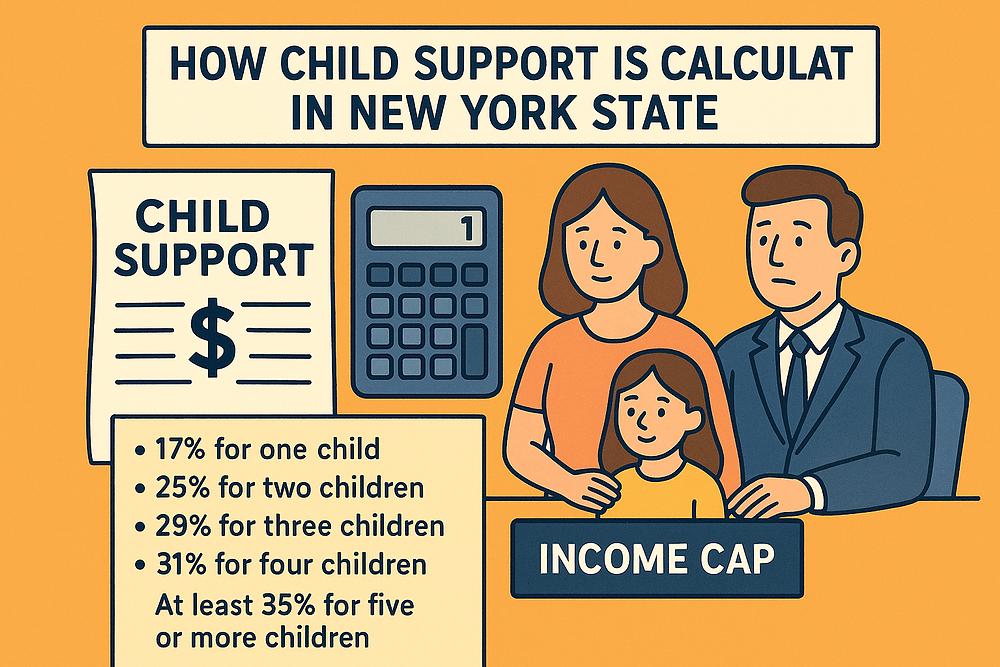
Once the combined parental income is determined, the CSSA applies a specific percentage based on the number of children being supported:
- 17% for one child
- 25% for two children
- 29% for three children
- 31% for four children
- No less than 35% for five or more children
This percentage is multiplied by the combined parental income, up to a cap, to calculate the total basic child support obligation. For example, if the combined income is $100,000 and there are two children, the total obligation would be $100,000 × 25% = $25,000 per year. The non-custodial parent (the one without primary physical custody) then pays their pro-rata share of this amount, based on their proportion of the combined income. If the non-custodial parent earns 60% of the combined income, they would pay 60% of the total obligation.
Step 3: The Combined Parental Income Cap
New York sets a cap on the combined parental income used in the basic calculation to prevent disproportionately high obligations in high-income cases. As of March 1, 2024 (and remaining in effect through 2025 and 2026), this cap is $183,000. For income above this cap, the court has discretion: It may apply the same percentage to the excess income or consider other factors, such as the child’s needs, the parents’ standard of living, and any special circumstances. This flexibility allows for tailored outcomes in affluent families.
Step 4: Adjustments for Low-Income Parents
To protect low-income parents from undue hardship, the CSSA includes safeguards:
- Self-Support Reserve: Set at $21,128 for 2025, this ensures the non-custodial parent retains enough income for their basic needs after paying support.
- Poverty Income Guideline: If the non-custodial parent’s income after deductions falls below the federal poverty level for a single person the minimum obligation is typically $25 per month.
Step 5: Add-On Expenses
The basic obligation covers everyday needs like food, clothing, and shelter, but additional “add-ons” may be required for:
- Unreimbursed health care expenses (including insurance premiums)
- Child care costs necessary for the custodial parent to work or attend school
- Educational expenses, such as private school tuition if deemed appropriate
- Extracurricular activities or special needs
These are typically divided pro-rata between the parents, based on their income shares.
Potential Deviations from the Guidelines
Although the CSSA provides a formula, courts may deviate from it if applying the formula would be unjust or inappropriate. Judges consider factors such as:
- The child’s standard of living before separation
- The financial resources of each parent
- The needs of the child, including special health or educational needs
- Non-monetary contributions by parents
- Any other factor the court deems relevant
Any deviation must be explained in writing by the court.
Contact a Syracuse Child Support Attorney Today
Calculating child support in New York can seem straightforward, but nuances like income imputation, add-ons, and deviations often require legal expertise to navigate effectively. If you’re facing a child support matter in New York State, an experienced Syracuse child support attorney can provide compassionate, knowledgeable representation and help you achieve a fair outcome. Contact us today for a confidential consultation to discuss your case.
For more information on child support, please visit our Child Support in New York State and Frequently Asked Questions pages
Disclaimer: This blog post is for informational purposes only and does not constitute legal advice. Laws and guidelines can change, so always verify with current statutes or a professional.

Address
| Monday | 8:30 AM - 4:30 PM |
| Tuesday | 8:30 AM - 4:30 PM |
| Wednesday | 8:30 AM - 4:30 PM |
| Thursday | 8:30 AM - 4:30 PM |
| Friday | 8:30 AM - 4:30 PM |
| Saturday | Closed |
| Sunday | Closed |
Contact Us Now