- Contact Us Now: (315) 234-4935 Tap Here To Call Us



Dividing Retirement Savings and Pensions in a New York Divorce: What You Need to Know


As an experienced Syracuse divorce attorney serving clients across Central New York, I often see clients concerned about how their hard-earned retirement savings and pensions will be handled during a divorce. These assets are frequently among the most valuable in a marriage, and their division can significantly impact your financial future. In this post, I’ll explain how New York courts approach dividing retirement savings and pensions under the equitable distribution framework, the key tools used, and practical considerations to protect your interests.
Equitable Distribution and Retirement Assets
New York is an equitable distribution state, meaning marital property, including retirement savings and pensions, is divided fairly but not necessarily equally during a divorce. Only the portion of retirement assets considered marital property (typically accumulated during the marriage) is subject to division. Separate property, such as contributions made before the marriage or after a divorce filing, generally remains with the original owner.
Types of Retirement Assets Subject to Division
Retirement assets that may be divided in a New York divorce include:
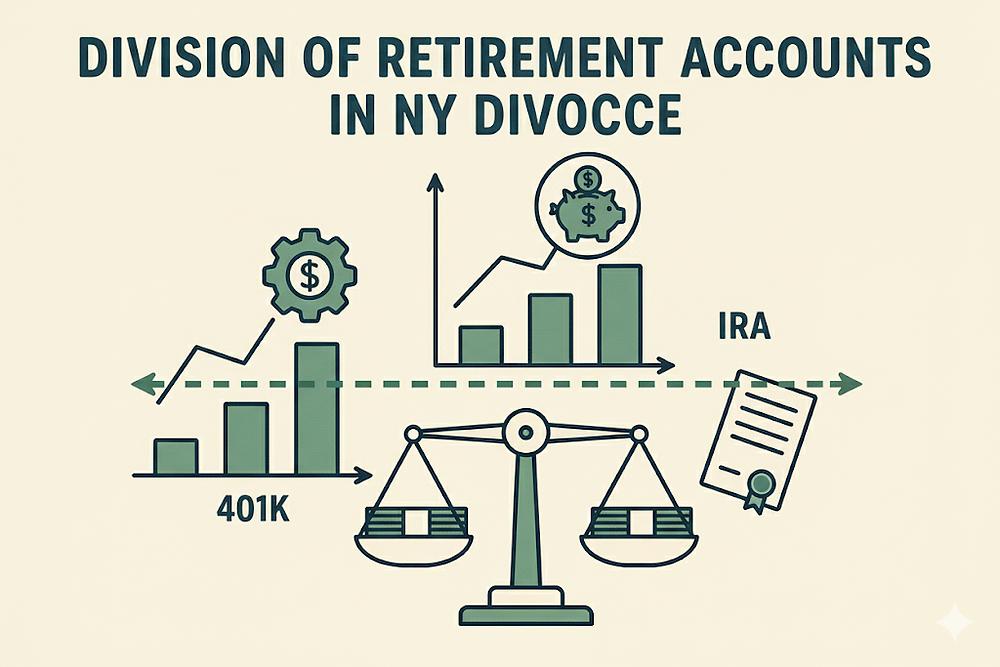
- Defined Contribution Plans: Such as 401(k)s, 403(b)s, IRAs, and thrift savings plans, where contributions are made during the marriage.
- Defined Benefit Plans: Pensions that promise a specific monthly benefit upon retirement, often based on salary and years of service.
- Other Plans: Deferred compensation plans, profit-sharing plans, or employee stock ownership plans
The marital portion of these assets, contributions, earnings, or benefits accrued from the date of marriage to the divorce filing or separation agreement, is what’s divided. For example, if you started contributing to a 401(k) before marriage, only the contributions and growth during the marriage are typically considered marital property.
The Majauskas Formula: Dividing Pensions
Pensions are often divided using the Majauskas formula, a method that calculates the marital share of a pension. The formula determines the non-employee spouse’s share based on the length of the marriage relative to the employee’s years of service. It works like this:
- Marital Share Calculation: The marital portion is calculated as a fraction: (Years of service during marriage) ÷ (Total years of service at retirement). For example, if a spouse worked 20 years to earn a pension but was married for 10 of those years, the marital share is 50% (10 ÷ 20).
- Non-Employee Spouse’s Share: The court typically awards the non-employee spouse half of the marital share (e.g., 50% of 50% = 25% of the total pension), though this can vary based on equitable factors.
Qualified Domestic Relations Orders (QDROs)
To divide retirement assets like 401(k)s or pensions, courts often use a Qualified Domestic Relations Order (QDRO), a legal document that instructs the plan administrator on how to distribute benefits to the non-employee spouse. Key points about QDROs include:
- A QDRO ensures compliance with federal laws (like ERISA) and avoids tax penalties or early withdrawal fees for the receiving spouse.
- The QDRO specifies the percentage or amount each spouse receives and how benefits are paid (e.g., direct payments for pensions or a rollover to an IRA).
- Preparing a QDRO requires precision, as plan administrators have specific requirements. It’s often drafted after the divorce is finalized but should be planned early to avoid delays.
Each retirement plan is unique, so QDROs must be tailored to the specific plan’s rules.
Practical Considerations and Challenges
Dividing retirement savings and pensions can be complex due to:
- Valuation: Determining the present value of a pension or the marital portion of a 401(k) often requires actuaries or financial experts, especially for high-net-worth cases.
- Commingling: If separate retirement funds (e.g., pre-marriage IRA contributions) are mixed with marital contributions, tracing the separate portion can be challenging.
- Tax and Penalties: Improper division without a QDRO can trigger taxes or penalties, so professional guidance is critical.
- Future Benefits: For pensions not yet in pay status, decisions must be made about when and how the non-employee spouse receives their share.
Contact a Syracuse Divorce Attorney Today
Dividing retirement savings and pensions in a New York divorce requires careful planning to ensure fairness and compliance with legal requirements. If you’re facing a divorce and need guidance on protecting your retirement assets, contact our office for a confidential consultation with an experienced Syracuse divorce attorney who can help you achieve a fair outcome tailored to your unique situation.
For more details on the divorce process please visit our Divorce and Frequently Asked Questions pages
Disclaimer: This blog post is for informational purposes only and does not constitute legal advice. Laws and guidelines can change, so always verify with current statutes or a professional.

Address
| Monday | 8:30 AM - 4:30 PM |
| Tuesday | 8:30 AM - 4:30 PM |
| Wednesday | 8:30 AM - 4:30 PM |
| Thursday | 8:30 AM - 4:30 PM |
| Friday | 8:30 AM - 4:30 PM |
| Saturday | Closed |
| Sunday | Closed |
Contact Us Now